For both educators and EdTech advocates alike, the debate exists on which option is better:AI classrooms or smart classrooms, and do both actually define the future of education? While smart classrooms convert physical classrooms into digital ones with interactivity and connectivity features, AI classrooms use embedded intelligent adaptive learning systems. With both expected to bring impact and change come 2026, their potential and impact differ. Let us break it down.
Understanding Each Technology
Smart Classrooms are equipped with some or all of the following: projectors, interactive whiteboards, tablets, smart sensors and software that possibly manage room occupancy, and control room temperature, as well as facial recognition to monitor attendance. These technologies facilitate and enhance the ability to deliver multimedia lessons and provide collaborative and analytical tools. EdTech studies show that classrooms in India led by government initiatives experienced a 30% increase in engagement.
The classrooms of the future incorporate AI technology to analyze individual student learning patterns and automate functions such as grading and assessment. Systems such as Bright Class or Roombr utilize AI to provide real time feedback, determine and adjust to the emotional state of the user, and personalize their learning experience. The learning experience can be adjusted to visual or auditory learning styles, and can be done at the user’s own pace.
Main Differences: Smart vs AI
- Primary Differentiation: Smart Classrooms prioritize user friendly interactive technology, while AI Classrooms focus on the integration of personalized and adaptive intelligent systems.
- Content Presentation: Smart Classrooms utilize traditional teacher resources such as slide decks and videos. AI Classrooms utilize AI to develop customized teaching plans and quizzes.
- Learning and Assessment: Smart relies on traditional assessments, and AI uses advanced techniques such as predictive analysis.
- Room vs. Cloud: Classrooms (smart or AI) are limited by the physical space. AI Classrooms are cloud-based and thus utilize technology to cross the traditional classroom boundaries.
- Cost: Smart Classrooms can cost (est. 2026) anywhere from ₹5 to 15 lakhs. AI Classrooms will range from ₹ 10 to 30 lakhs with a subscription cost.
Advantages of Smart Classrooms
Digitization of teaching resources is an affordable entry point to teaching via Smart Classrooms. Teaching aids such as 3D models can replace physical diagrams and assist with visual learning. The Smart Classrooms are designed to assist with large classes and assist or replace shifts in teacher workload. Static teaching resources are a limitation. Teachers still maintain manual curation of learning resources.
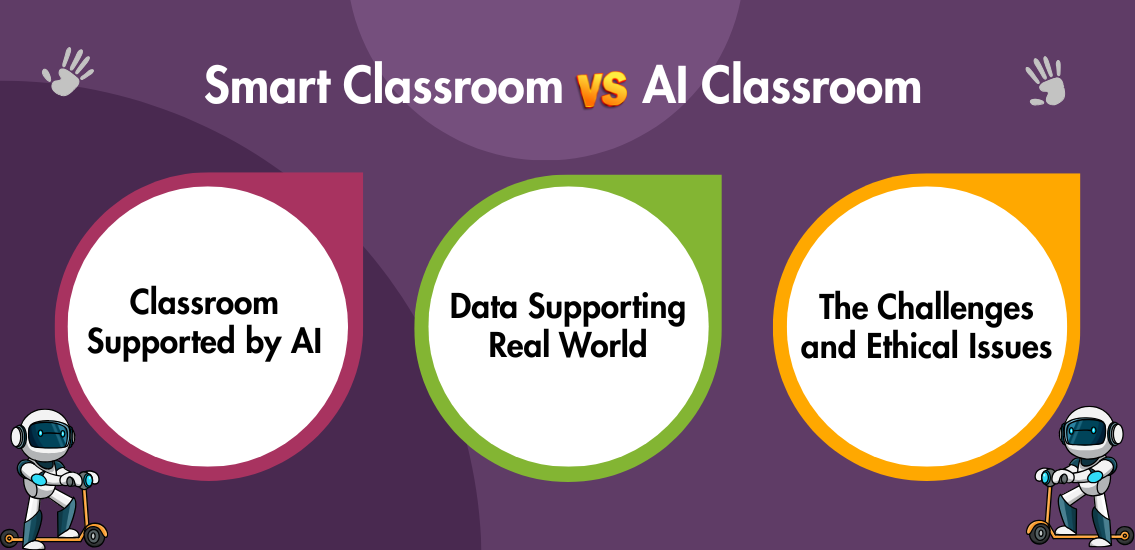
Classrooms Supported by AI
AI is changing the game when it comes to personal education. These technologies can monitor student progress and provide different types of activities, including “fast track” challenges to help more advanced learners, as well as remediation activities for learners who struggle. AI engages facial recognition to determine student engagement and can provide tutoring services through a chatbot. In the hybrid models of 2026, AI guarantees fairness by translating text and facilitating simulations in laboratories over the internet. Privacy issues, increased costs, and the risk of excessive dependence are drawbacks.
Data Supporting the Real World
AI in classrooms are projected to improve student performance by 15 to 25% in 2026. This is a greater improvement when compared to the 10% improvement for classrooms equipped with smart technologies. Even more so, AI technology is a powerful resource where smart technologies and tools are resourceful, such as in developing countries. Hybrid models also show promise with the Roombr model.
The Challenges and Ethical Issues
The Smart model presents a digital divide, while the AI model presents data privacy, which is the potential for strict data privacy regulations, algorithmic bias, and data privacy issues that are of greater concern than the GDPR, and teacher deskilling. Both systems also require additional training, a priority for administrators.
What is winning? The Hybrid Future
There is no competition; Smart technologies provide the infrastructure, and AI provides the intelligence. The 2026 forecast estimates that 70% of schools will incorporate hybrid models.
At The Adhyayana International Public School (TAIPS), The Top CBSE School in Coimbatore, The Classrooms are Smart Classrooms that are integrated with AI for immersive education. Visit our CBSE School to see the future.