Education has always evolved from chalk and talk to smart screens and AI-powered platforms. Today’s classrooms are no longer defined by textbooks alone. They are defined by curiosity, connectivity, and technology. Students today are digital natives. They think faster, engage differently, and expect learning to match the pace of the world they live in.
The changes of Classroom and the Learner
Modern students do not respond well to passive instruction. They need experiences that involve, challenge, and inspire them. When learning becomes interactive, attention follows naturally.
Technology makes this possible in powerful ways:
- Smart boards turn lessons into visual, interactive journeys
- Project-based platforms let students create instead of simply memorise
- AI-assisted tools personalise learning speed and style for every child
- Live simulations and virtual labs make abstract concepts tangible and exciting
STEAM and Robotics: Learning by Doing
One of the most transformative shifts in modern education is the move from theory to application. TAIPS leads this with a dedicated Robotics, AI, and STEAM programme, where students build, code, test, and problem-solve using real-world tools.
These sessions develop skills that go far beyond the curriculum:
- Critical thinking: students evaluate and refine their own solutions
- Collaboration: teams work together toward shared goals
- Creativity: there is no single “right answer,” only better approaches
- Communication: students present their work, building confidence alongside knowledge
When a student builds a working robot in class, they are not just learning science they are learning how to think.
Technology Integration That Goes Beyond Gadgets
Effective technology in education is never about the device it is about what the device enables. TAIPS ensures that digital tools are embedded meaningfully into teaching, not added as a novelty.
Key strategies include:
- Faculty trained continuously in e-learning methodologies and digital pedagogy
- Blended instruction combining traditional classroom wisdom with digital exploration
- Assessments designed around application, not rote recall
- Regular exposure to global content, research platforms, and collaborative learning spaces
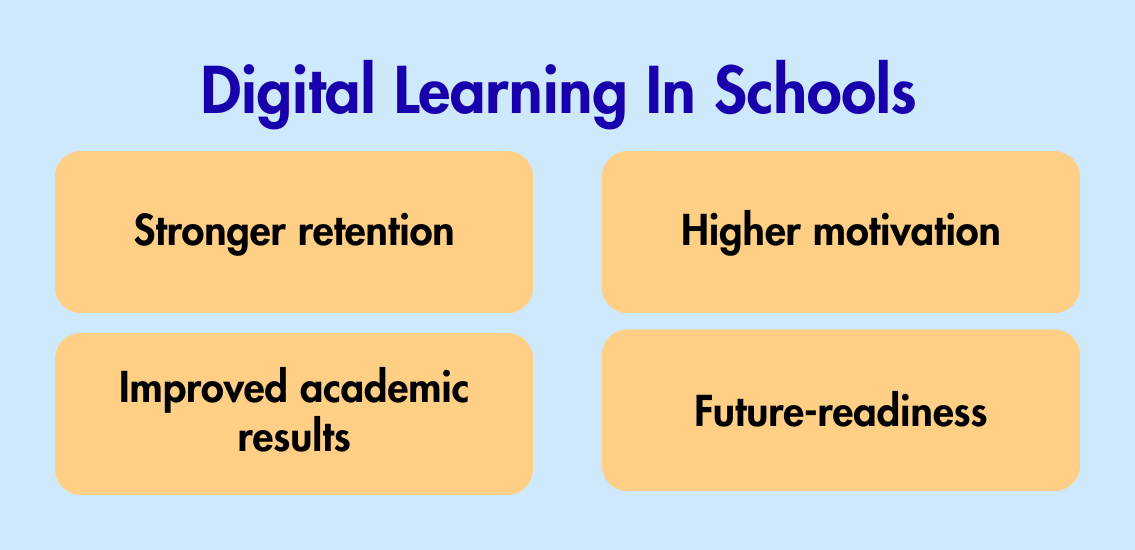
Benefits Students Experience Every Day
The impact of technology-led education shows up where it matters most in the day-to-day growth of students:
- Stronger retention: visual and interactive content is absorbed and remembered better
- Higher motivation: students enjoy learning when it feels relevant and dynamic
- Improved academic results: structured digital tools support deeper understanding
- Greater independence: students learn to research, question, and discover on their own
- Future-readiness: skills built today align directly with careers and opportunities ahead
Education’s greatest gift has always been the ability to unlock potential. Today, that potential is unlocked faster, deeper, and more inclusively than ever before, because of how schools are rethinking the learning experience. Digital learning in schools is not a passing trend; it is the new foundation of meaningful, future-ready education.