
Diwali is a time of joy and celebration, especially for young children of school-going age between Pre-KG and Grade 8. Parents, on the other hand, can feel pulled in different directions. They enjoy seeing their children celebrate Diwali, but are also concerned about their children losing their academic rhythm during the break and the impact this may have when they return to school. The good news is that, at TAIPS, we have experience in balancing both and have several strategies to help parents plan for their children to enjoy the break while engaging in gentle learning.
Set a daily routine.
During the school year, children often have set bedtimes. Set wake-up times to help them go to school on time and be well rested. This is not the case during holidays, and often the lines between day and night can be blurred. Making sure the children stick to a normal bedtime and wake-up time a few days prior to the school day can help the children not feel drained and tired on their first school day back. Younger children can do 30 minutes to an hour of gentle practice. Older children between Grades 6 and 8 can do a little more during the quieter times of the day before the visitors arrive.
Make the Most of Learning Opportunities at Diwali
You don’t have to go out of your way to find opportunities for learning at Diwali. Diwali holidays for Parents can be a great time to turn everyday celebrations into simple and enjoyable learning experiences for children. For example, maths is an option. Younger children can count the sweets they receive, while older children can help calculate a shopping budget. Writing is another option. Older children can write an entry or a summary of what happened that day. The celebrations also provide opportunities for learning languages. If a child can find someone to talk to in that language, they can practise naturally through conversation. The possibilities are endless.
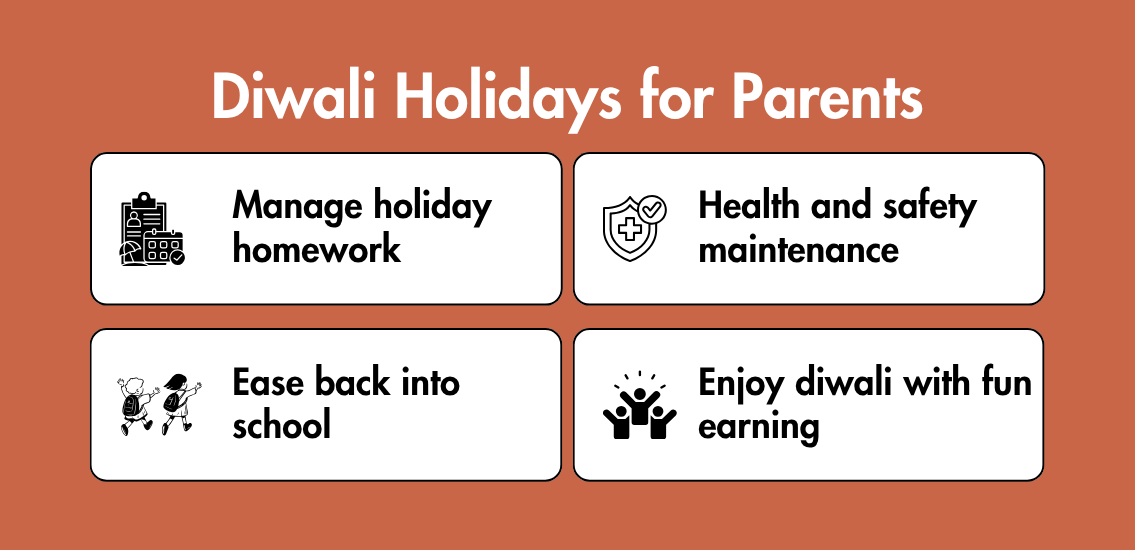
Manage Holiday Homework
If your child’s school gives holiday homework, you can manage it better by breaking it up through the holiday instead of saving it for the last two days. This will help your child build the confidence and responsibility to work independently. Most children, with their parents’ help, can manage to do a major portion of their holiday homework themselves. I know how busy teachers are. A note or a quick email to your child’s teacher will not be amiss if you feel a particular task is beyond your child’s capabilities. Teachers will appreciate that you let the teacher know ahead of time. That helps the teacher get ready. Makes life simpler for everyone.
Health and Safety Maintenance
Teach your child to maintain safety during the festival season when they might be drawn to enjoying sugary, deep-fried treats and excited to attend and host large family gatherings. Teach your child to get lots of sleep, eat fruit and drink water, especially if they will be attending host family gatherings. Maintaining a safe distance and not playing with crackers unsupervised are a few safety rules you can teach your child. Many families choose to celebrate Diwali with a lamp-lit celebration instead of a large family get-together. Celebrations can be modified to suit young children who can’t enjoy an event as long as older children.
Ease Back into School
A few days before school begins, start getting back into the back-to-school routine. Take your child’s moments from the festival and use those to help your child get ready. As your child goes back to school with things to share, they leave behind the strong feeling of not wanting to go to school.
Enjoy Diwali with Fun Learning
A planned break can integrate festival time and learning time and the break can also combine party with study. TAIPS encourages families to uphold good learning habits for children during Diwali vacations by planning engaging, interactive and interesting activities around the festival and organizing fun celebrations for the family. Positive interactions with teachers reinforce the need to maintain school readiness despite the lights and celebrations at home.