Have you ever seen how seamlessly and smoothly children communicate with their friends or with their grandparents and teachers in different languages? This ability to code switch or move from Tamil to English or Hindi to another language is not just an ability to master different languages; it is a sign that symbolizes a higher level of emotional and intellectual ability. Since the world is changing at a faster pace, we consider multilingual education to be one of the greatest gifts we could give our children. The ability to communicate in more than one language engraves an ability to think in different ways, expand their horizons, and become confident to adapt to any environment.
What is Multilingual Education?
We can define multilingual education in a more simple and straight-forward way by saying that it is education in two or more languages. Multilingual education respects the home languages of the children and introduces other regional and global languages. For instance, children may learn basic and foundational subjects in their mother tongue as they learn to be proficient in other languages English, Hindi, and other foreign languages like Spanish or French.
Why Multilingual Education Matters Today

Improves Brain Development
More than one language means that children’s brains are constantly learning new linguistic patterns, and solving new problems on a daily basis through pattern recognition and memory. This daily “exercise” increases the strength of connections in the brain, enhancing its ability to focus and its flexible cognitive ability. All over the world, studies show that multilingual people are better at tasks that require quick on-the-spot thinking and decision making.
Boosts Academic Success
Education through multiple languages enhances learning, reading, and writing abilities over a range of subjects. Multilingual education improves students’ ability to think in new ways, allowing them to grasp meaning and context on a deeper level. It enables them to move away from rote learning and active knowledge application, creative thinking, and problem solving skills.
Fosters Appreciation of Different Cultures
Indian classrooms include students from different cultures and speak different languages. Multilingual classrooms encourage students to appreciate these differences. It teaches children that every language has its own stories and traditions that are valuable. This creates a sense of unity in diversity, an important trait for an inclusive society.
Equips Learners with International Skills
The world appreciates adaptability. Whether it is advancing education in a foreign country or growing further in competitive sectors, multilingual people are at an advantage. Students are more confident in communicating, negotiating, and collaborating digitally across different countries.
Encourages Self Confidence and Self Expression
Multilingual education lessens the fear of students focusing on expression. They adapt to different social environments easily. It encourages students to voice their thoughts in a clear and confident manner.
How Parents and Teachers Can Support Multilingual Learning
- PARENTS: Start at home. Foster your child’s ability to express themselves in your first language and promote the language they are learning in school. Make learning fun and natural through reading storybooks, singing songs, and playing games in multiple languages. Learn to appreciate all languages as the tools for learning and communication that they are, instead of viewing English as the only language of value.
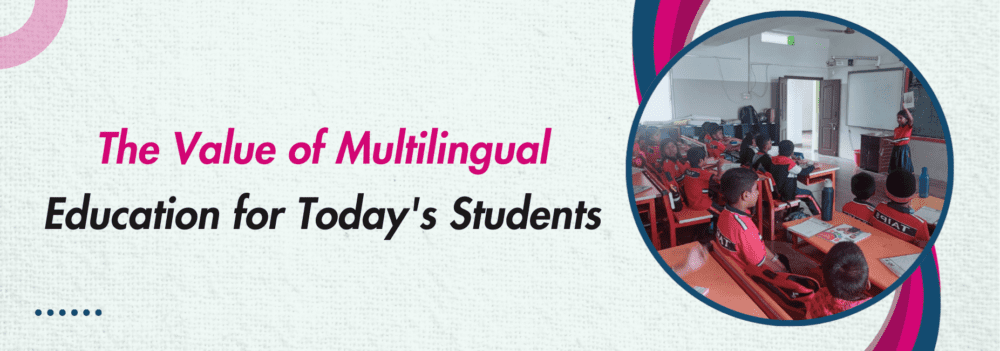
- TEACHERS: Make every lesson a multilingual lesson and help students develop an appreciation for all the languages in the classroom. Use local examples and simple local phrases to explain complex concepts. Activities that incorporate mixed language use, such as group work, story-telling, and classroom discussions, increase student confidence and are preferable to the control offered by monolingual classroom settings.
- STUDENTS: You are every language you learn. Be curious and don’t be shy to learn a language that will allow you to access a new world. Use educational videos, read simple texts, and practice speaking.
The Future of Education is Multilingual
As the world becomes more connected, it is increasingly important for education systems globally to teach multiple languages. Being multilingual prepares students academically, but also provides students with essential life skills such as empathy, flexibility, and leadership. Multilingual students become more confident to socially and academically engage with others, more creative, and have higher emotional intelligence to resolve conflicts and accommodate others.
At, The Adhyayana International Public School (TAIPS), we understand the importance of these skills and work to expand them through providing an inclusive and language rich training. We do not simply teach languages; we utilize them to link various forms of knowledge with diverse cultural and creative expressions.